


Odoo 19 for US teams, built from evidence instead of assumptions
Oakland delivers Odoo discovery, migration, USD reconciliation, and branch rollout projects remotely from the UAE. Meetings can be arranged around the client's agreed US time zone; support hours and response times apply only when written into the operating agreement. Reviewed 2026-11-06.
El producto
Odoo, en pantalla
Antes de la propuesta y antes del presupuesto: este es el software que sus líderes de finanzas y operaciones abrirán cada mañana.
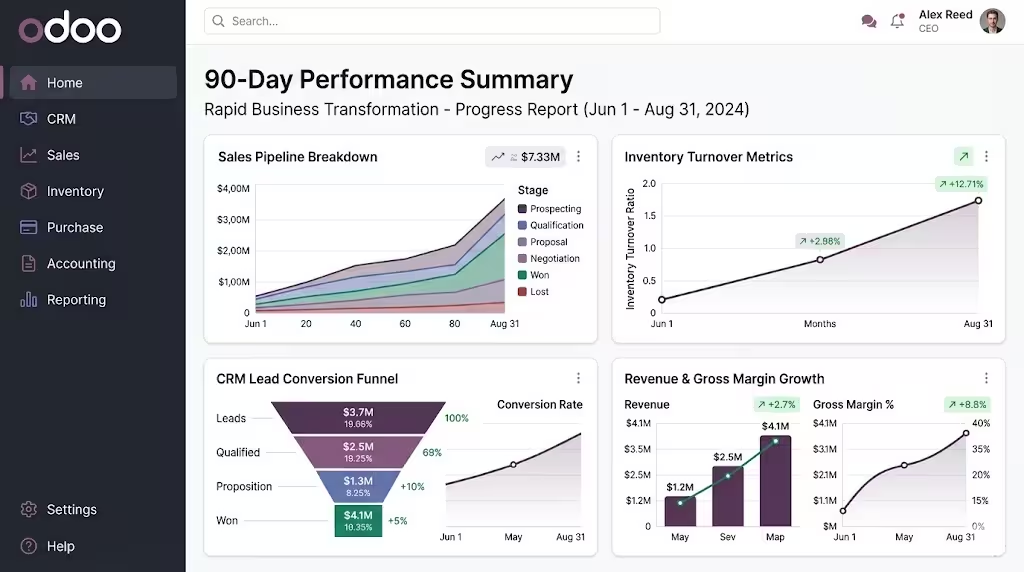
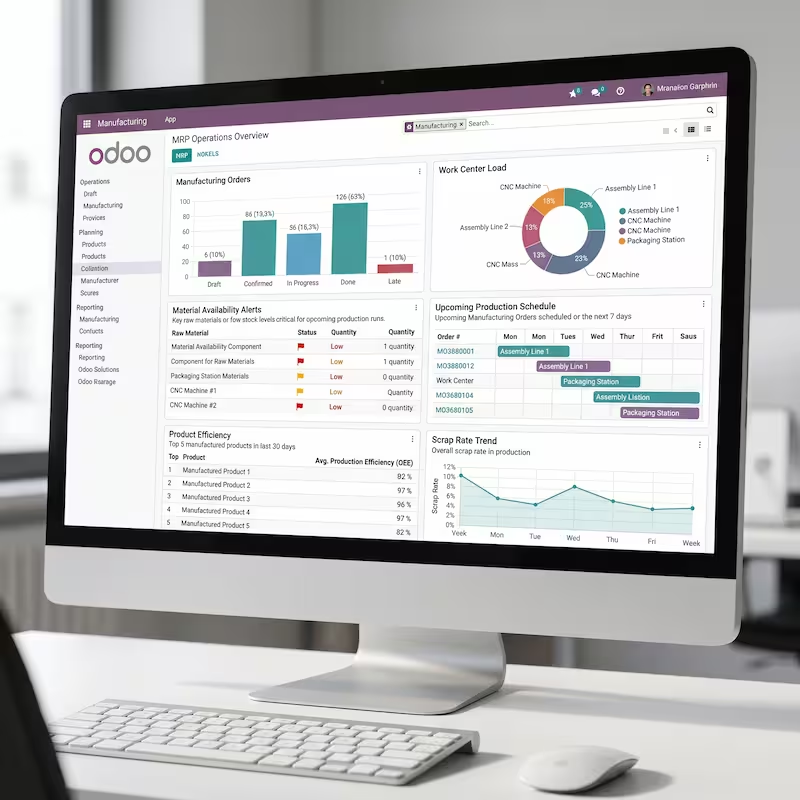
Pantallas estándar de Odoo, no una versión de demostración personalizada.
Start with operating evidence, not a national template
A US Odoo program begins with the way the business actually sells, buys, stocks, pays, employs, and closes. Bring a sales invoice and credit note, a vendor bill and payment, a payroll summary with sensitive values removed, a bank statement, a processor settlement, a stock movement, and the current trial balance. Record the legal entity, ship-from and ship-to locations, customer exemption position, transaction currency, payment channel, and reviewer for each sample.
The United States has no broad-based federal general sales tax. State and local rates, taxability, exemptions, sourcing, administration, and economic-nexus thresholds vary. Federal excise taxes and other federal taxes remain separate. Wayfair does not create a universal national threshold. Use the Congressional Research Service overview, IRS business-tax guidance, state-tax directory, and GAO's post-Wayfair review as starting evidence, then obtain current advice for the business and each applicable taxing jurisdiction.
The discovery output is a decision register, not a compliance badge. Each row names the workflow, evidence, proposed Odoo 19 configuration, adviser or provider decision, client owner, test case, and acceptance result.
Buyer situations that deserve a controlled blueprint
A QuickBooks or Zoho Books migration needs more than a file conversion. A multi-state seller needs more than a tax-rate table. A distributor needs more than an inventory total. A retailer needs more than a successful card transaction in a demo. Each situation has different evidence and stop conditions.
Use the discovery worksheet to classify the current condition and the proof required:
- the current bookkeeping system cannot represent the required branches, warehouses, approvals, or operational links;
- finance needs USD and foreign-currency documents with an approved rate source and residual ownership;
- state and local registrations, product taxability, exemptions, and sourcing need adviser review before configuration;
- QuickBooks or Zoho Books data has duplicates, custom fields, incomplete open-item links, or inconsistent tax mappings;
- branches need repeatable POS opening, tender, cash-close, outage, and reconnection procedures;
- payroll spans supported and unsupported jurisdictions, so scope must stop rather than imply nationwide state and local payroll coverage;
- bank, payment, and hardware assumptions need institution- and device-specific evidence.
The blueprint names what belongs in standard Odoo 19, what requires a third party, what requires custom development, and what remains a client procedure. A proposed implementation phase is not approved until those boundaries have owners.
Establish the documented Odoo 19 US baseline
Odoo 19 documents l10n_us as the base US accounting localization and l10n_us_reports for US accounting reports. The package supplies a US chart and localization baseline, configurable default sales and purchase taxes, GAAP-oriented report labels, a direct-method cash flow statement, and a check register. The labels and starting structure do not guarantee GAAP, IRS, or SEC compliance. The finance owner and the company's accounting advisers must approve the final chart, mappings, and reports.
Use the official Odoo 19 US fiscal-localization page as the capability reference. Record the installed modules and version in the workbook. Test one ordinary sale and purchase, a credit note, an exempt or non-taxable scenario identified by the adviser, a payment, a check layout, a foreign-exchange difference, and the resulting Balance Sheet, Profit and Loss, General Ledger, Cash Flow, and check register. Reconcile report lines to journal entries rather than relying on report names.
Acceptance evidence includes the selected package, chart decisions, tax mapping, sample journal entries, report exports, reviewer names, and unresolved exceptions. The global Gold Partner credential is not part of this evidence.
Build the jurisdiction and transaction worksheet
Create one row per representative transaction with these columns: entity, seller registration, ship-from, ship-to, product or service, customer type, exemption evidence, sourcing decision, direct or marketplace channel, tax treatment, and jurisdiction-source URL. Add the current adviser, review date, and approval state. Repeat the exercise for returns, discounts, shipping charges, and a product with a possible federal excise issue.
Maintain separate physical-presence and economic-nexus paths for every applicable taxing jurisdiction, including local and home-rule administrations where relevant. Capture current thresholds, measurement periods, sourcing rules, marketplaces, registration and filing evidence, the official source and review date, and the adviser's decision. Do not treat a state-only review as sufficient and do not paste one jurisdiction's threshold into another.
For every configuration decision, preserve the source transaction, mapped tax or fiscal position, exemption-certificate reference, calculation result, and reviewer. Include an expired certificate, a destination change, and a refund. The Wayfair opinion belongs in the legal research trail, not in a universal configuration rule.
Copy this worksheet once per applicable taxing jurisdiction and complete every client-entry area:
- Jurisdiction: Client entry: ______________________________
- Official source and review date: Client entry: ______________________________
- Physical-presence evidence: Client entry: ______________________________
- Economic-nexus threshold and measurement period: Client entry: ______________________________
- Sourcing and marketplace treatment: Client entry: ______________________________
- Registration and filing evidence: Client entry: ______________________________
- Adviser decision: Client entry: ______________________________
Keep AvaTax calculation separate from tax obligations
account_avatax supports tax calculation once an Avalara account, license, and configuration are in place. The Odoo 19 AvaTax documentation also documents that excise tax is not supported. Calculation does not determine nexus, register the business, file a return, or remit tax.
The readiness workbook therefore separates four owners. The tax adviser approves nexus, registration, taxability, exemptions, and filing obligations. Avalara account owners provide the company profile, jurisdictions, credentials, and sandbox access. Oakland configures and tests the agreed integration. Client finance users compare document results and preserve evidence for their filing process.
Test address sourcing, product mappings, an exemption, a credit note, a rejected address, unavailable service, and a transaction outside the configured profile. Record request identifiers and non-sensitive response evidence without placing the license key in the workbook. Include a federal excise candidate as a stop case rather than forcing it through AvaTax. Acceptance requires reviewed calculations and a documented fallback, never a claim that Avalara or Odoo has taken over the client's statutory responsibilities.
Separate information returns, payroll, and filing channels
The 1099 export supports applicable IRS information-return workflows through a third-party filing service. It is not automatically submitted to the IRS or any state or local authority. Review the included and excluded journal items, vendor eligibility, period, and totals with the responsible adviser. Use the IRS information-return guidance and retain the third-party submission receipt separately. The export does not prove that every required vendor or payment is included.
The W-2 export supports third-party SSA submission. The Form 940 and Form 941 exports support third-party IRS submission. State and local filing obligations, forms, channels, data, and acceptance evidence are assessed separately and are not implied to use those federal exports. None of these exports files automatically. FUTA is employer-paid, not employee withholding. Use the IRS employment-tax guide and filing and payment guidance to assign employer review, deposit, filing, and evidence ownership.
At the review date, the Odoo 19 US payroll page lists exactly AL, AZ, CA, CO, FL, GA, ID, IL, IA, MS, NV, NJ, NY, NC, OR, TX, VT, VA, WA and DC. Nationwide state and local payroll coverage is not implied. Work locations, state parameters, and local requirements need review. An unsupported payroll work jurisdiction must be flagged before configuration and assessed separately. Odoo can generate employee NACHA payment files, but generation is not bank upload, ACH processing, final settlement, tax deposit, or tax filing. The ADP work-entry export is a CSV file for upload to ADP, not a direct API.
Reconcile USD without assuming one rounding rule
USD is normally presented with cents, while 31 USC 5101 recognizes dollars, cents, and mills. Do not infer that every calculation rounds to two decimals. Odoo's currency rounding factor, product and pricelist precision, tax calculation's round-per-tax and round-per-line options, cash rounding, and currency-conversion behavior are assessed separately. Payment and foreign-currency reconciliation are tested separately; no independent payment-rounding or FX-rounding setting is assumed.
The migration control contains source document ID, transaction currency and amount, exchange-rate value, rate date and source, expected USD, actual USD, debit and credit totals, configured precision and rounding rule, residual, explanation, owner, and approval. Include values ending in 0.01, 0.04, 0.05, and 0.09, negative equivalents, large values, and mixed-currency documents. No blanket tolerance is allowed.
Use multi-currency documentation and cash-rounding documentation to design tests. The statutory currency text does not choose the system's rounding method. Every residual requires an explanation and sign-off; an unexplained difference blocks cutover.
Treat QuickBooks migration as a rehearsal
Start by identifying the QuickBooks product, version, company files, locations, classes, inventory method, currencies, and connected apps. Export capability varies, so the workbook records the actual extract and its limitations rather than promising a universal connector. Preserve the original files, hashes, export date, and source owner.
Map stable external IDs for accounts, contacts, items, tax records, documents, and payments. Establish dependencies before importing open transactions. Keep raw source amounts and exchange rates alongside expected and actual USD values. Reconcile the trial balance, open receivables and payables, inventory quantities and valuation, bank balances, and a sample of document-to-payment links.
Run repeated imports in a controlled environment and keep rejection logs. Test duplicates, missing parents, invalid account mappings, partial payments, credits, foreign-currency documents, and late landed costs. A successful import count is not migration acceptance. Finance and operations owners sign the reconciliation pack and remaining-exception register before cutover. Continue with the QuickBooks comparison and the USD reconciliation workbook.
Apply the same discipline to Zoho Books
Zoho Books discovery starts with organizations, modules, branches, custom fields, currencies, and enabled workflows. A field with the same display name in two organizations does not prove compatible meaning or export structure. Capture the actual API or file extracts available to the client and the field-level mapping evidence.
Create a source-to-target dictionary for contacts, items, accounts, taxes, custom fields, open invoices and bills, credits, payments, and inventory. Mark each field as migrate, derive, ignore with approval, or unresolved. Rejected contacts or accounts stop dependent documents under a documented rule; they are not silently dropped. Preserve raw values and external IDs so a rejected row can be corrected and replayed without duplication.
Reconcile USD totals and operational links independently. Verify that a custom field needed for tax, exemption, branch, or reporting decisions survives the migration or has a named replacement. The Zoho Books comparison and the migration workbook turn these checks into a repeatable rehearsal rather than a one-time conversion claim.
Investigación de socios de Oakland
El mercado de socios de Odoo, en cifras
Oakland mantiene su propia instantánea estructurada del directorio oficial de socios de Odoo. Con ella sabemos dónde la capacidad es escasa, dónde las referencias son reales y cómo se ve un implementador creíble en su país.
| Región | Países | Socios | Referencias |
|---|---|---|---|
| Europe | 40 | 1,037 | 28,229 |
| Latin America & the Caribbean | 34 | 1,435 | 19,854 |
| Middle East | 13 | 677 | 11,753 |
| Africa | 41 | 612 | 10,138 |
| South Asia | 8 | 368 | 4,761 |
| North America | 2 | 433 | 4,269 |
| Southeast Asia | 10 | 302 | 3,263 |
| Asia-Pacific | 11 | 176 | 2,081 |
| Central Asia & the Caucasus | 6 | 33 | 283 |
Source: Oakland OPRD — October 2026 snapshot of the official Odoo partner directory.
Validate banks, payments, and files as separate steps
Odoo 19 documents US check layouts, NACHA export, customer ACH receipt through Authorize.Net eCheck and Stripe online-payment integrations, vendor direct-deposit completion in Wise, and ISO 20022 XML generation. Outgoing NACHA files and Wise vendor payments are separate from customer ACH receipt. Stripe POS Terminal is also a separate flow, not an outgoing vendor-payment mechanism. The Federal Reserve ACH overview supplies network context. None of these features proves support for the client's exact account, currency, or flow, and no generated file or feed is payment or settlement.
Record institution, account type, provider, integration method, currency, fee treatment, settlement account, cut-off rule, and approval owner for every flow. For NACHA and ISO 20022, retain the generated file, bank-upload confirmation, bank approval, and final statement evidence as distinct artifacts. Wise completion occurs in Wise. ISO 20022 upload and approval happen outside Odoo. Customer ACH status is checked against the provider and settlement record.
Plaid or other bank synchronization depends on Enterprise and provider support, available history, and the institution. The bank-synchronization guide does not justify a real-time or universal-coverage promise. Include delayed, duplicate, and missing transactions and a manual-statement fallback in acceptance.
Bound e-invoicing and federal procurement scope
There is no universal US private-sector e-invoicing or Peppol mandate. Federal agency IPP and procurement requirements apply in their specific context. The OMB memorandum and IPP overview belong in the applicability review when a customer transacts with a federal agency.
The reviewed Odoo 19 electronic-invoicing documentation does not document native US Peppol registration, Treasury IPP connectivity, or a US-specific EDI localization. A generic XML option, another country's Peppol workflow, or an Odoo 20 announcement does not close that gap.
If the business needs agency or trading-partner exchange, record the exact counterparty, required format, endpoint, provider, acknowledgments, corrections, retention, and support owner. Label provider or custom development explicitly and test it against the counterparty's current specifications. Do not call the result universal US compliance.
Connect inventory valuation and landed costs to finance
Migration and go-live need quantity and value, not only an item list. Record item categories, units of measure, warehouses, lots or serials where used, costing method, valuation accounts, and the opening cut-off. Reconcile on-hand quantities and valuation to the source and to the general ledger.
Landed-cost scenarios identify freight, insurance, duties, and other charges, the eligible receipts and vendor bills, allocation basis, valuation method, and accounting result. Use the Odoo 19 landed-cost guide to design the test, including a late charge after receipt and a partial sale before the charge arrives. Confirm AVCO or FIFO prerequisites where Odoo 19 requires them; Standard Price needs a separately validated path.
Evidence includes receiving documents, source bills, allocation worksheets, journal entries, inventory valuation, and reviewer approval. A late landed cost or unpriced receipt remains an exception until reconciled, not a rounding difference to hide.
Rehearse every branch and POS exception
A branch template covers network, browser, printer, scanner, cash drawer, receipt layout, taxes, opening cash, tender mapping, users, and daily close. Device compatibility is proven at the site with the actual hardware and browser. Check layouts used for vendor payments are tested separately from customer receipts.
The Odoo 19 POS guidance supports order handling during temporary outages with later synchronization. Payment terminals, customer registration, and real-time stock need connectivity, and requested invoices are generated after reconnection. Keep the browser session open and do not reload it or clear its site data before synchronization completes, because those actions can discard locally stored orders.
Run a routine sale, exempt-sale review, refund, mixed tender, declined payment, cash over/short, and offline-order cases. After reconnection, compare local and server orders by count, reference, and status; reconcile payments, stock, invoices, and uninvoiced orders before signing the close. Processor gross/net settlement and fees are matched to the provider statement, not inferred from the POS total.
Train roles through routine and exception work
US English training is organized around tasks and permissions rather than a generic module tour. Cashiers practice sales, refunds, offline recovery, and close. Branch managers review exceptions and approve evidence. Receivers and purchasers handle receipt, vendor-bill, and landed-cost scenarios. Accountants and controllers review tax mappings, USD residuals, reports, and third-party exports.
Payroll reviewers learn the supported-state boundary, employee and employer tax distinctions, the separate federal and state/local filing responsibilities described above, and ADP work-entry CSV evidence. Treasury and payment operators distinguish file creation, bank upload, approval, and statement settlement. Administrators manage access, credentials through approved secrets handling, audit logs, and escalation without embedding secrets in training material.
Each learner completes a routine and an exception in a sandbox, with a task card, expected evidence, assessor, and remediation decision. Champions receive the task cards and ownership for first-line coaching. Hypercare exit depends on observed adoption and clean close evidence.
Make the commercial and delivery path inspectable
The USD proposal separates fixed-fee discovery, fixed-scope implementation phases, migration and reconciliation, custom development, training, and optional support. Odoo subscriptions are linked to current Odoo pricing without copying a numeric price. Avalara and other provider fees, bank charges, payment fees, hardware, infrastructure, approved travel, and client internal effort are separate lines or responsibilities.
Oakland delivers projects remotely from the UAE. Meetings can be arranged around the client's agreed US time zone. Support hours and response times apply only when written into the operating agreement. Odoo 20 material is used only as a version fence, never as Odoo 19 evidence.
Use the four working assets before approving scope: discovery and tax readiness, migration and USD reconciliation, branch/POS go-live, and role-based training. Then review the USD commercial framework and delivery and product answers. Reviewed 2026-11-06.
Bring one transaction, source extract and close reconciliation
Tell us about your entities, states, current systems, transaction currencies, banks, providers, branches and payroll locations. We will separate documented Odoo 19 capability from adviser, provider, bank, hardware and client decisions.
Contáctenos
Buhaira Corniche, 43132 Sharjah,
Emiratos Árabes Unidos